


The question "which is better, a blower or a vacuum cleaner?" sounds like a household debate - but in an industrial context, it masks a deeper engineering decision: should you buy separate pressure and vacuum equipment, or use one machine that does both?
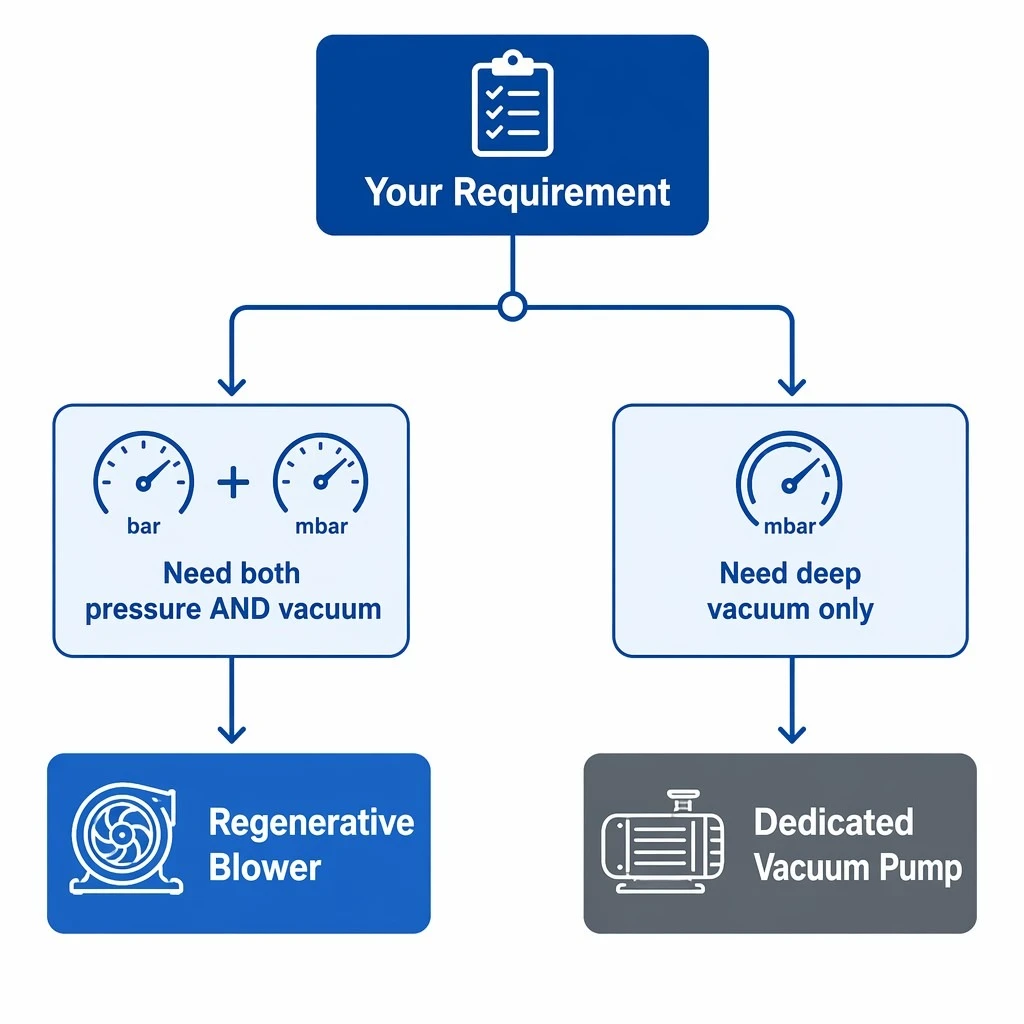
Here is something many first-time buyers do not realize: a regenerative blower is both a blower and a vacuum pump. The same machine that pushes air at 300 mbar on the outlet side pulls vacuum at -300 mbar on the inlet side - simultaneously if needed. This is because a regenerative blower's impeller and side channel design works symmetrically.
This dual functionality is transformative for applications like vacuum lifting plus pneumatic conveying on the same production line. Instead of buying and maintaining two separate machines, a single regenerative blower handles both tasks - cutting capital cost, reducing floor space, and simplifying your spare parts inventory.
Despite the dual-purpose appeal, there are scenarios where a standalone vacuum pump wins. Regenerative blowers max out at around -450 to -500 mbar vacuum. If your process needs deep vacuum (-900 mbar or below), such as vacuum forming, freeze drying, or semiconductor manufacturing, you need a rotary vane pump, liquid ring pump, or dry screw pump.
While regenerative blowers are 100% oil-free in the air path, some medical and food-grade applications require even stricter contamination control - HEPA-filtered exhaust and polished stainless steel contact surfaces. Specialized vacuum pumps built to FDA or EHEDG standards have the edge here.
For most industrial buyers across Asia, the Middle East, and South America - who need reliable, low-maintenance equipment for aquaculture, wastewater, packaging, and light conveying - the regenerative blower's dual capability makes it the clear winner over buying separate systems.