


Centrifugal blowers have been the backbone of industrial air movement for over a century, and for good reason. Despite the emergence of competing technologies like regenerative and high-speed turbo blowers, the centrifugal design continues to dominate large-scale applications. Here are the five advantages that keep it there.
The first and most compelling advantage is **high volume capability**. A single centrifugal blower can move 5,000 to 100,000+ CFM - volumes that would require an impractically large regenerative blower or a prohibitively expensive positive displacement machine. For ventilation systems in factories, cooling towers, combustion air supply to boilers, and dust collection networks serving multiple pickup points, centrifugal blowers deliver the sheer cubic-feet-per-minute throughput that no other compact blower type can match.
Second is **peak efficiency at the design point**. A well-designed backward-curved centrifugal blower operating at its Best Efficiency Point (BEP) achieves 80–88% static efficiency. At industrial electricity rates, this efficiency advantage over a regenerative blower (50–65%) or Roots blower (55–70%) translates to thousands of dollars in annual energy savings for large installations. For a 75 kW unit running 6,000 hours per year at $0.10/kWh, every 5% efficiency gain is worth approximately $2,250 in annual savings.
Third is **mechanical simplicity and low manufacturing cost**. A centrifugal blower consists of an impeller, a shaft, two bearings, and a scroll housing - fewer than ten major components. This simplicity makes centrifugal blowers the most affordable blower type per CFM of capacity. A 5 kW centrifugal blower costs roughly **50–70% of an equivalent regenerative blower** and **30–40% of a Roots blower package**.
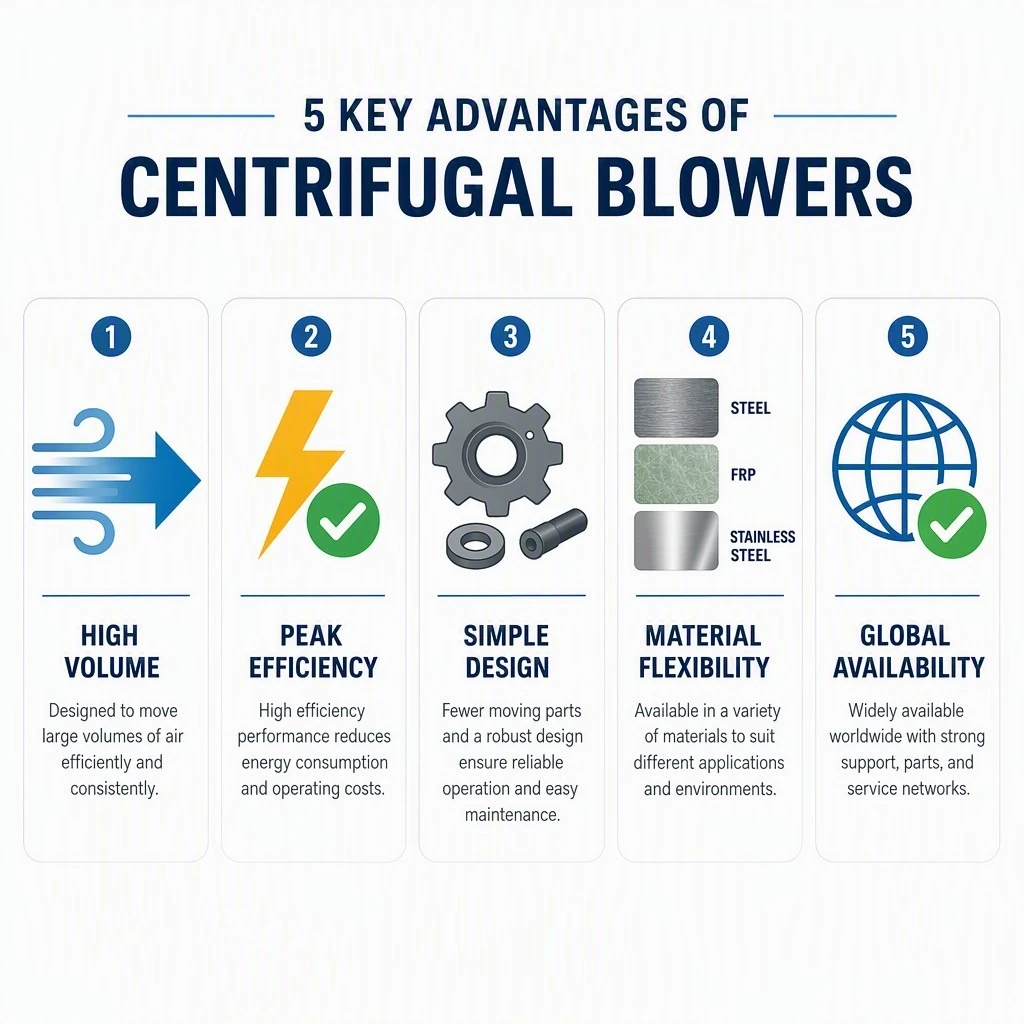
Fourth is **material flexibility**. Centrifugal impellers and housings can be fabricated from mild steel, stainless steel, aluminum, fiberglass-reinforced plastic (FRP), or exotic alloys depending on the application. This makes centrifugal blowers adaptable to corrosive environments (chemical plants with FRP housings), high-temperature exhaust (stainless steel rated to 400°C+), and food-grade processing (polished 304/316 stainless). Regenerative blowers, by contrast, are overwhelmingly aluminum - great for general industrial use, but limiting in chemically aggressive environments.
Fifth is **extensive industry knowledge and parts availability**. Centrifugal blowers are manufactured by hundreds of companies worldwide, with standardized frame sizes, mounting dimensions, and spare parts. A replacement bearing or impeller for a common centrifugal blower model can be sourced within 24 hours in most industrial regions. This supply-chain maturity reduces downtime risk and maintenance planning complexity.
The centrifugal blower is not the right choice for every application - it struggles with variable pressure, is prone to surge, and its efficiency collapses off-design. But for high-volume, fixed-condition systems with a known operating point, it remains the most cost-effective air-moving solution available.