


"How long do HVAC blowers last?" For residential systems, the answer is 10–20 years. But in the industrial world, blower lifespan is measured in operating hours, not calendar years - and the numbers can vary dramatically depending on type, operating conditions, and maintenance practices.
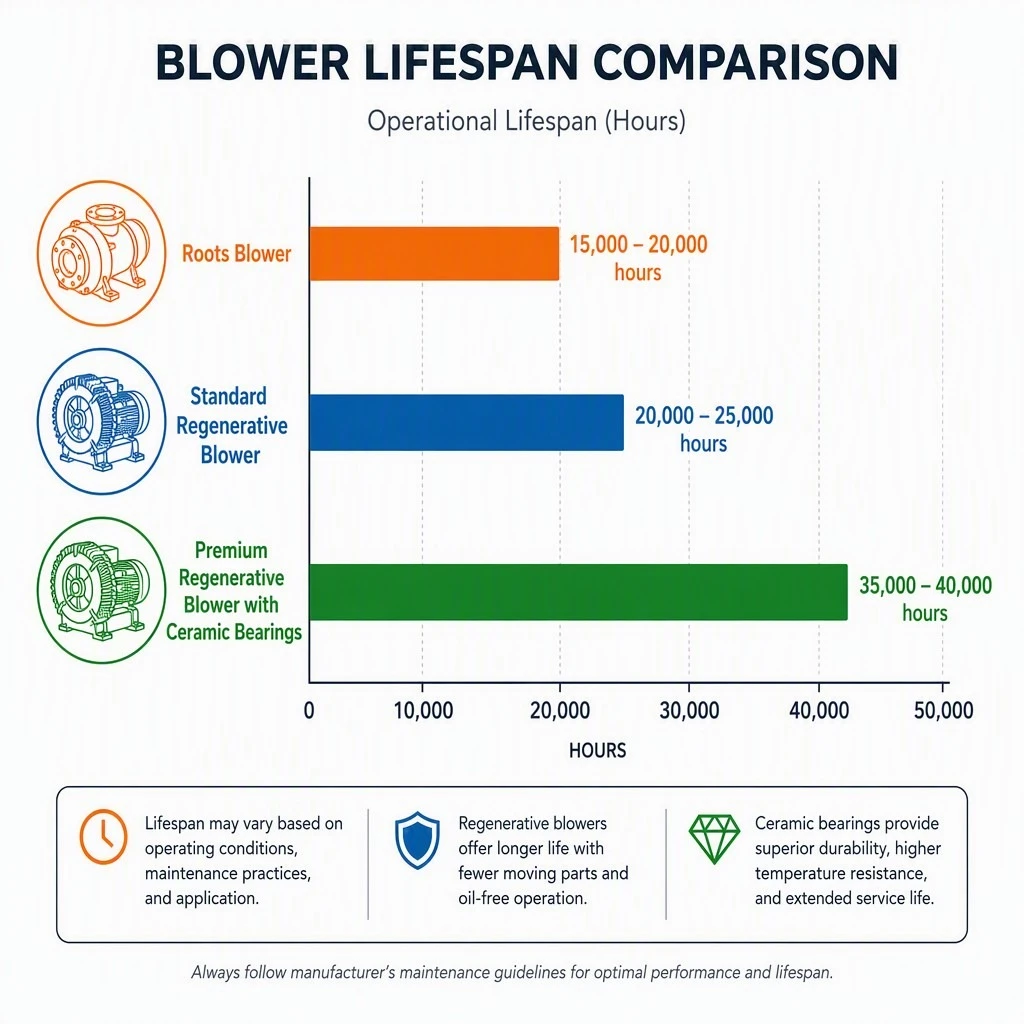
Regenerative blowers (side channel blowers) are among the longest-lasting blower types because their design eliminates mechanical contact between moving parts. The impeller spins inside the housing without touching it - there are no gears, no pistons, and no oil to degrade. The only wear components are the bearings.
With standard deep-groove ball bearings, expect 20,000–25,000 hours of continuous operation - roughly 2.5 to 3 years of 24/7 duty. Upgrading to ceramic hybrid bearings or premium SKF/NSK brands can push this to 35,000–40,000 hours. At that point, a simple bearing replacement restores the blower to like-new performance.
Positive displacement blowers have more internal contact points - timing gears, lobe seals, and oil-lubricated bearings. The gears typically dictate the overhaul interval. Well-maintained Roots blowers reach 15,000–20,000 hours before needing gear inspection or replacement. Neglect the oil change schedule, and that number drops to under 8,000 hours.
Four factors kill blowers early: dust and particulates without proper intake filtration, voltage instability causing motor winding overheating, duty cycle abuse (running an intermittent-duty blower continuously), and improper mounting that transmits vibration back into the bearings.
Assume a regenerative blower costs $800 and runs 24/7. At 25,000 hours (roughly 3 years), your cost per operating hour is about $0.03 - before electricity. Add a bearing replacement ($100) and you get another 3 years. Longevity is not just about hours - it is about what those hours cost you.