


CFM (Cubic Feet per Minute) is the most quoted specification in the blower industry - and the most misunderstood. "How many CFM is good for a blower?" has no universal answer, because the right number depends entirely on what you are moving and how fast you need it moved. Here is how to calculate your actual CFM requirement and avoid the two most expensive sizing mistakes.
CFM only makes sense alongside pressure. A blower rated at 300 CFM at 0 mbar will deliver far less - perhaps 180 CFM - when pushing against a system resistance of 200 mbar. This is because regenerative and centrifugal blowers follow a performance curve: as back-pressure rises, flow rate drops. Positive displacement blowers are more pressure-insensitive but still lose some flow to internal leakage.
Many buyers default to "bigger is better" and order a 10 HP blower when a 3 HP unit would suffice. This costs you twice: higher purchase price and permanently higher electricity consumption. A 7.5 kW motor running unnecessarily large costs roughly $3,000–$5,000 extra per year in electricity compared to a properly sized 2.2 kW unit (at $0.12/kWh, 24/7 operation).
The opposite mistake is worse. An undersized blower runs at or beyond its maximum rated pressure continuously, generating excessive heat. Discharge temperatures climb above 140°C, the motor draws overcurrent, and thermal protection trips repeatedly. Instead of saving money, you destroy a blower within months.
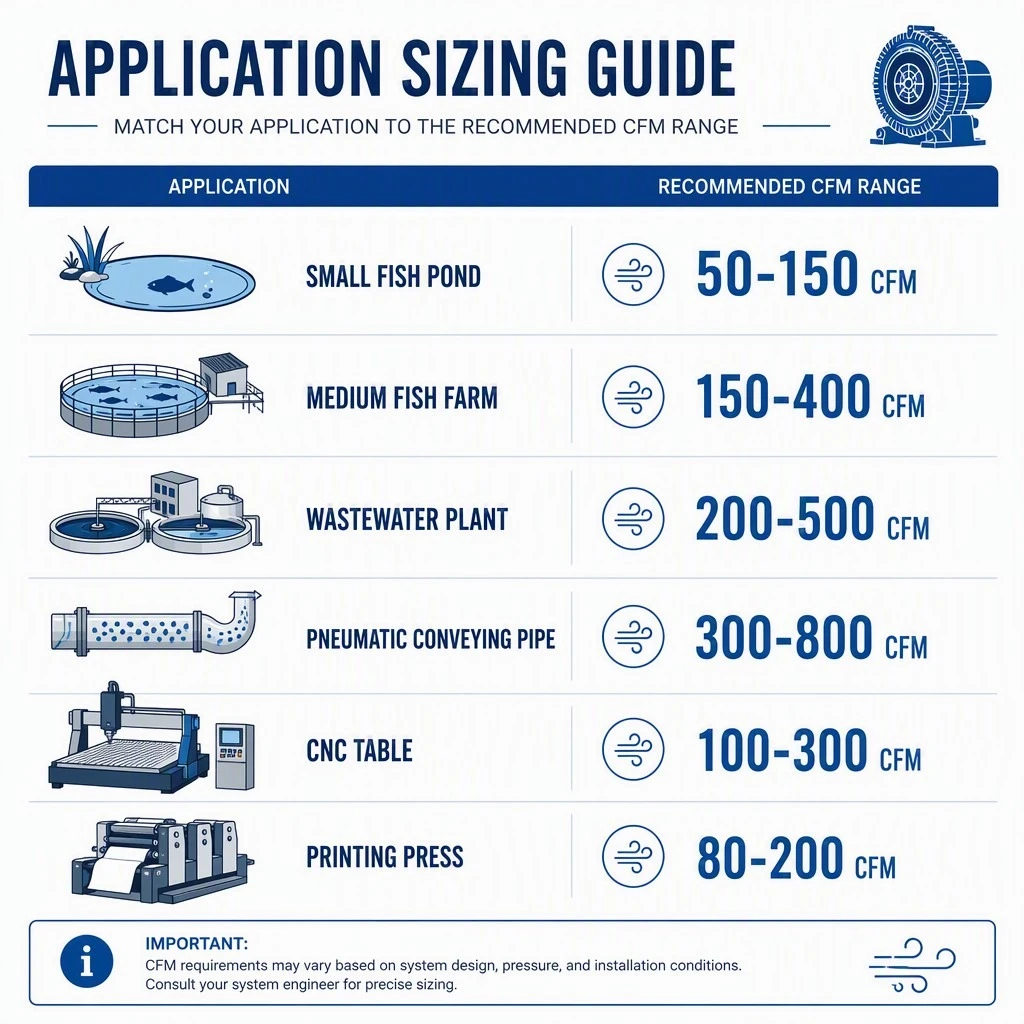
To size correctly: Step 1 - calculate your total airflow need by adding up all the air consumption points in your system. Step 2 - measure or estimate working pressure, adding 20% for system aging and minor blockages. Step 3 - select a blower with your CFM and pressure meeting at 60–80% of its maximum curve. This gives you headroom for system variations without running the blower at its thermal limit.
A correctly sized blower pays for itself in energy savings within the first year. The "good" CFM is not a magic number - it is the one your process actually needs.