


"What is the maximum pressure for a blower?" It sounds straightforward - but the answer changes completely depending on which blower technology you are evaluating.
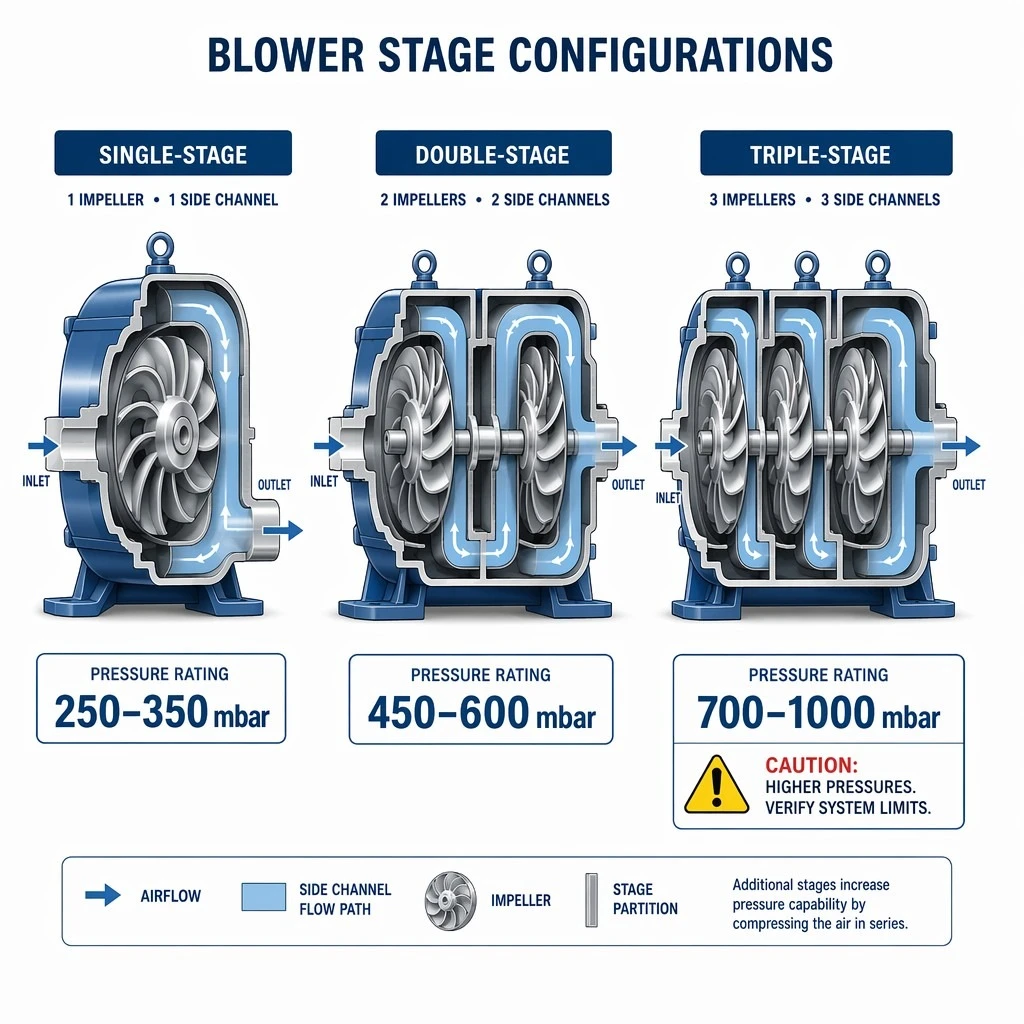
Regenerative blowers (side channel blowers) occupy the pressure range between centrifugal fans and positive displacement machines. Single-stage units deliver 250–350 mbar (25–35 kPa, 3.6–5.0 psi), covering most common applications - aquaculture aeration, vacuum lifting, and light pneumatic conveying. Double-stage units step up to 450–600 mbar (45–60 kPa, 6.5–8.7 psi) for higher-pressure tasks like deep-tank wastewater aeration.
Positive displacement (Roots) blowers push well beyond regenerative limits. A standard two-lobe or three-lobe Roots blower delivers 0.4 to 1.0 bar (40–100 kPa) in single-stage configuration. However, that pressure comes with trade-offs: higher noise, oil lubrication requirements, and pulsating outlet flow.
At the other end of the spectrum, centrifugal blowers and fans produce large air volumes but at relatively low pressure - typically 50–150 mbar (5–15 kPa). They are not suitable for applications that require pushing air through significant resistance, such as underwater aeration diffusers or powder conveying lines.
Here is where buyers get into trouble. The "maximum pressure" printed on a blower datasheet is the absolute peak the machine can achieve momentarily - not a safe continuous operating point. Running any blower at 100% of its rated maximum causes excessive heat buildup (140–180°C), motor overcurrent, and accelerated bearing wear.
The safe continuous operating range is 60–80% of the rated maximum. If a single-stage regenerative blower is rated at 300 mbar maximum, design your system to run at 180–240 mbar. The right pressure rating is not the highest number you can find - it is the one your application actually demands, with 20–40% headroom for safe continuous operation.