


Efficiency means different things in different contexts. When buyers ask "what is the most efficient type of blower?", the real question is: most efficient at what? Here is how the three major blower categories stack up across the metrics that matter for industrial applications.
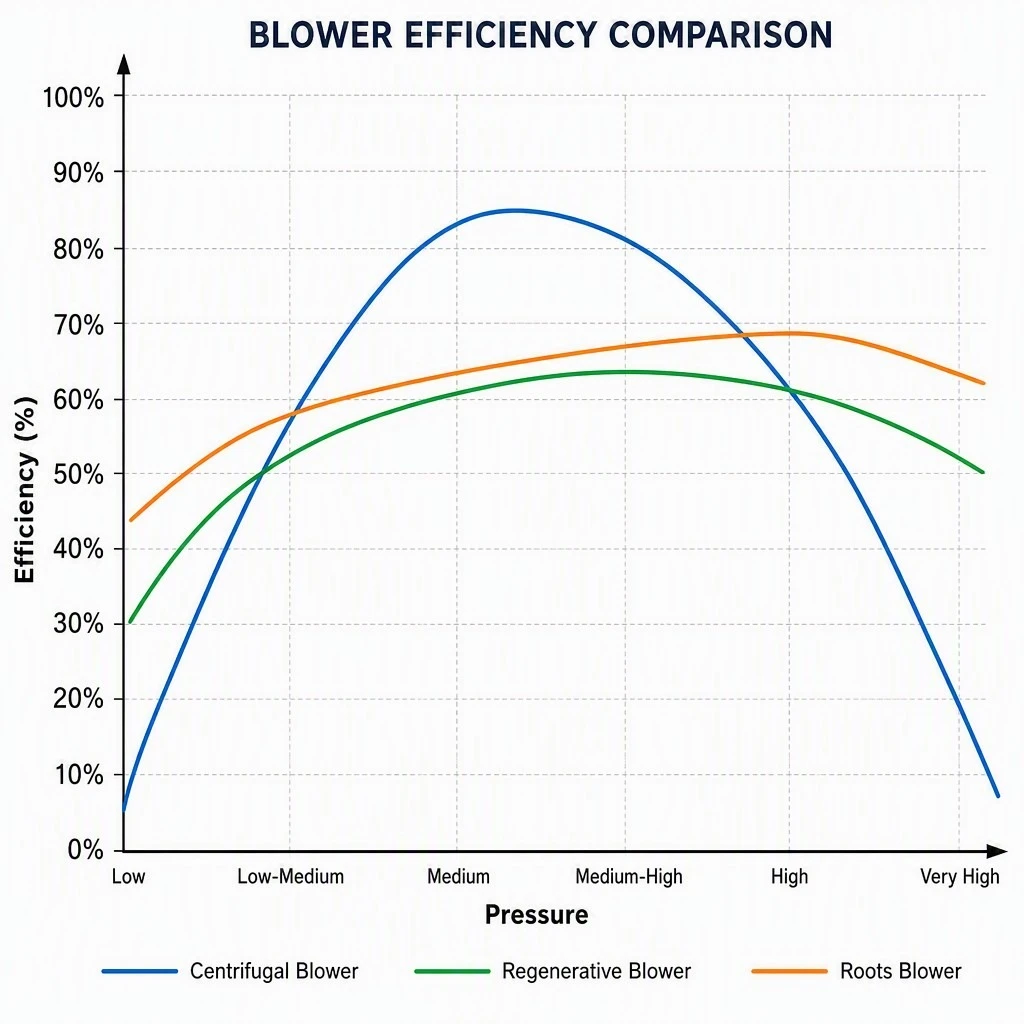
At the motor shaft level, **centrifugal blowers with backward-curved impellers** achieve the highest peak efficiency - typically 80–88% under ideal conditions at their design point. This is because the backward-curved blade geometry converts kinetic energy into pressure with minimal turbulence and flow separation. In large HVAC and process air applications where the blower operates at a fixed speed against a known static pressure, a well-designed centrifugal unit delivers the lowest electricity cost per cubic meter of air moved.
However, peak efficiency at a single operating point is not the whole story. Regenerative blowers operate at **50–65% efficiency** at the impeller level, which appears lower on paper - but this number ignores context. A regenerative blower maintains relatively flat efficiency across a wide pressure range, while a centrifugal blower's efficiency drops sharply once it deviates more than 15–20% from its best efficiency point (BEP). In systems with variable back-pressure - such as wastewater aeration where water levels fluctuate - the regenerative blower often consumes less total energy over a year than a centrifugal unit that spends half its time operating off-design.
Roots blowers sit at **55–70% volumetric efficiency** but have a unique advantage: their flow rate stays nearly constant regardless of pressure. For processes that demand guaranteed minimum airflow under all conditions - cement conveying, for example - this pressure-insensitive characteristic is a form of functional efficiency that no centrifugal machine can match.
The emerging efficiency leader, however, is the **high-speed turbo blower with air-foil bearings and permanent magnet motors**. These machines achieve 85–92% system efficiency by eliminating mechanical contact losses entirely. They command a premium price - often 3–5× the cost of an equivalent regenerative blower - but the energy savings can recover the investment within 2–3 years in 24/7 applications exceeding 15 kW.
The bottom line: match your efficiency definition to your application. If your operating point is fixed, choose a centrifugal blower at its BEP. If your pressure varies, a regenerative blower's flat efficiency curve wins over time. And if your power requirement exceeds 15 kW with continuous duty, investigate high-speed turbo technology before committing to any traditional design.