


When engineers debate "which is better, Roots blower or centrifugal fan?", the answer inevitably begins with "it depends." These two machines occupy opposite corners of the blower performance map, and choosing the wrong one for your application guarantees either excessive energy costs or process failure.
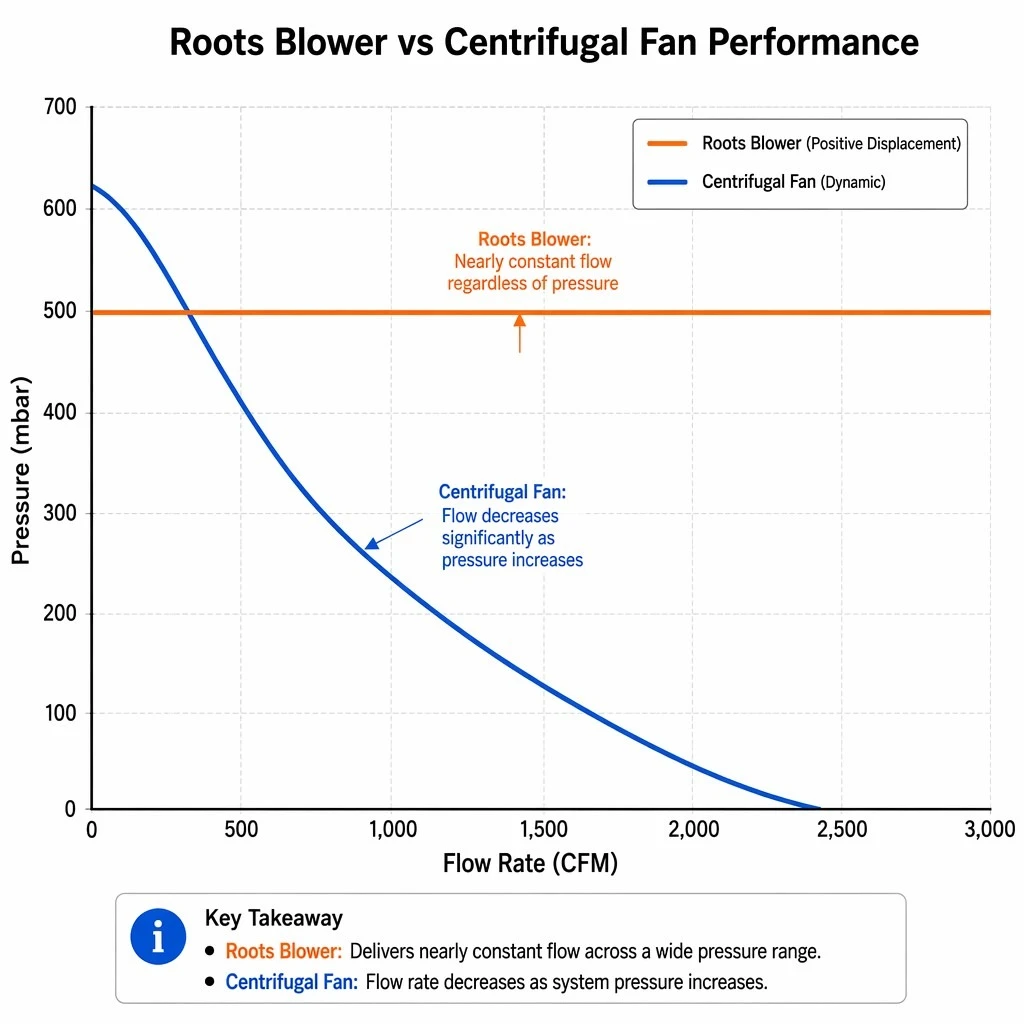
Roots blowers are **positive displacement machines** - they trap and push a fixed volume of air with every rotation. Their defining characteristic is a nearly flat flow curve: as system pressure increases from 0 to 1 bar, the flow rate drops by only 5–15% due to internal leakage. This makes them ideal for applications where **guaranteed minimum airflow at varying pressure** is non-negotiable. A cement tanker unloading system cannot afford to have its blower lose 40% of its flow because the pipe resistance changed. The Roots blower delivers - at the cost of noise (80–95 dBA), oil lubrication requirements, and pulsating discharge flow that needs downstream dampening.
Centrifugal fans operate on a completely different principle. They accelerate air radially through a rotating impeller and convert velocity into pressure in a volute casing. Their performance follows a **steep flow-pressure curve**: at zero pressure (free air), flow is maximum; as system resistance increases, flow drops - sometimes dramatically. A centrifugal fan delivering 2,000 CFM at 50 mbar might produce only 800 CFM at 150 mbar. This sensitivity to system conditions makes centrifugal fans unsuitable for applications with variable back-pressure unless controlled by a variable frequency drive (VFD).
The efficiency comparison depends entirely on the operating point. At their **best efficiency point (BEP)**, a backward-curved centrifugal fan achieves 80–88% efficiency - higher than a Roots blower's 55–70%. However, deviate more than 20% from the BEP, and the centrifugal fan's efficiency collapses while the Roots blower hums along at consistent - if modest - efficiency across its entire pressure range.
Cost is another dimension. A 15 kW Roots blower package typically costs **2–3× more** than an equivalent-power centrifugal fan, and installation costs are higher due to the need for inlet/outlet silencers, a foundation with vibration isolation, and an acoustic enclosure. The centrifugal fan is cheaper to buy and install but more expensive to operate in variable-pressure applications.
For industrial buyers, the decision framework is: if your system pressure is stable and you need high volumes (1,000+ CFM), a centrifugal fan at its BEP is the most cost-effective choice. If your pressure varies, you need guaranteed flow, or your application involves heavy particulates that would erode centrifugal blades, the Roots blower justifies its higher upfront cost through reliability at the operating extremes.