


The short answer is **yes - ring blowers (regenerative blowers) are among the few blower types specifically designed for continuous 24/7 operation**. In fact, this capability is one of the primary reasons they dominate industries like wastewater treatment, aquaculture, and pneumatic conveying where downtime is not an option.
The secret lies in the mechanical design. A regenerative blower has **no metal-to-metal contact** inside the air path. The impeller rotates inside the housing with a carefully engineered clearance gap - typically 0.1–0.3 mm - that prevents friction, eliminates the need for internal lubrication, and removes the primary wear mechanism that limits other blower types. The only components that wear are the **bearings**, which are sealed, greased-for-life units rated for tens of thousands of hours.
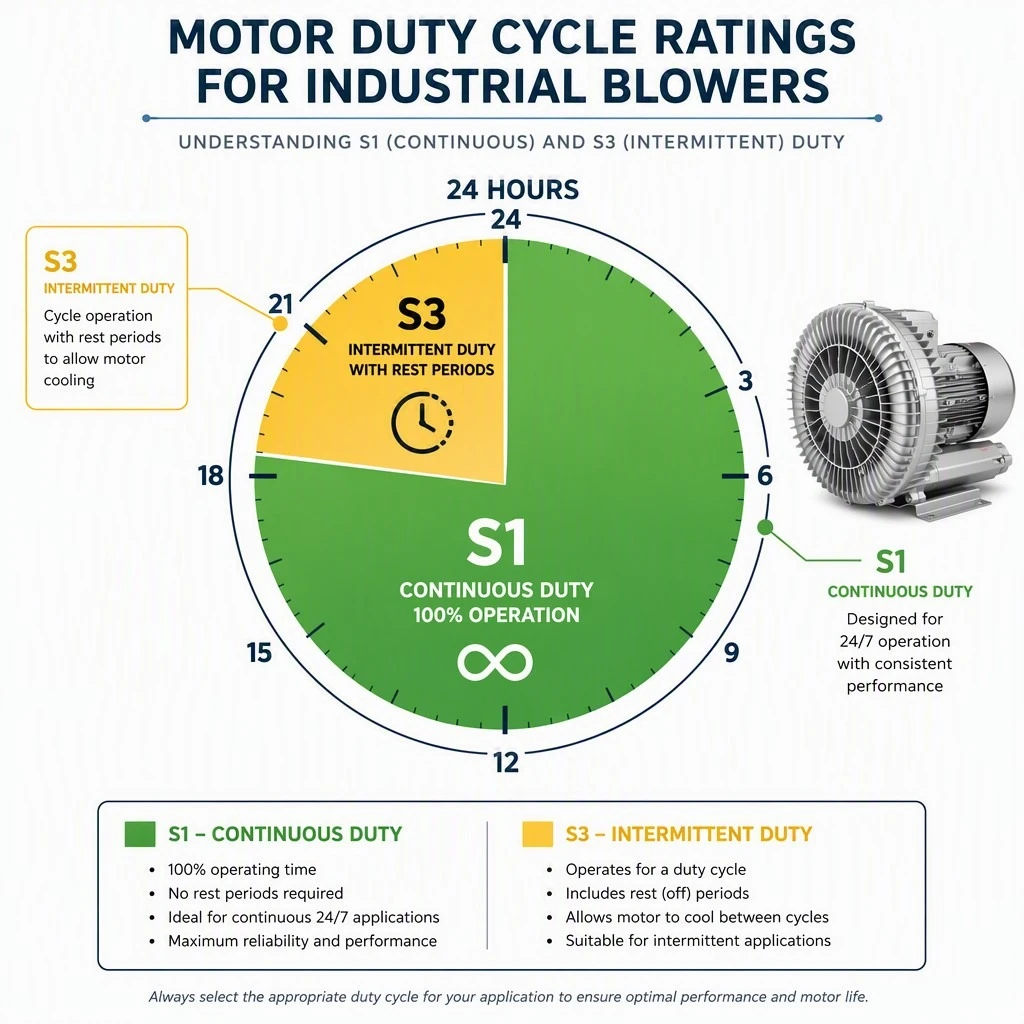
To be precise, continuous operation depends on the **motor duty rating**, not the blower itself. Industrial regenerative blowers are almost universally paired with **S1 (continuous duty)** motors, meaning the motor is designed to run at its rated power indefinitely without overheating. Look for this classification on the motor nameplate. An S1-rated 5.5 kW motor can run 8,760 hours per year - every hour of every day - without exceeding its insulation temperature limits.
There are, however, practical limits to continuous operation. The most important is **operating pressure**. Running a regenerative blower continuously at 90–100% of its maximum rated pressure pushes discharge air temperatures into the 140–180°C range. At these temperatures, the aluminum housing expands, the impeller clearance tightens, and thermal stress accumulates in the motor windings. Continuous duty at 60–80% of maximum pressure is the safe operating window - this keeps discharge temperatures below 100–120°C and preserves the blower's designed 20,000+ hour bearing life.
Environmental factors also matter for continuous outdoor operation. Regenerative blowers installed at aquaculture farms or wastewater plants face humidity, salt spray, and temperature extremes. The standard configuration handles these conditions well - the aluminum housing resists corrosion, and the IP55-rated motor enclosure keeps moisture out. For coastal installations or tropical climates, specify an **IP56 or IP65 motor** and consider adding a rain hood over the intake filter.
Temperature cycling is the hidden killer of "continuous" blowers. A machine that runs non-stop for three months and then shuts down for maintenance can develop condensation inside the motor housing during the cooling period. Installing a **space heater** (anti-condensation heater) in the motor terminal box - a small, inexpensive option from most manufacturers - prevents this by keeping the windings slightly above ambient temperature during shutdowns.
Bottom line: yes, ring blowers can run continuously, and in many industries they do exactly that for years at a time with only bearing replacements as scheduled maintenance. Just operate within the 60–80% pressure band, verify S1 motor rating, and protect against condensation during rare shutdowns.