


Industrial blowers are not a single product category - they are a family of machines spanning dramatically different operating principles, pressure ranges, and application domains. Here is the complete taxonomy that every buyer should understand before making a purchasing decision.
At the highest level, blowers divide into two fundamental categories based on how they pressurize air: **positive displacement** and **dynamic**.
Positive displacement blowers work by trapping a fixed volume of air and physically pushing it through the system. Sub-types include:
- **Roots blowers (twin-lobe):** Two figure-8 lobes rotate in opposite directions. Flow is nearly constant regardless of pressure. Dominant in pneumatic conveying and wastewater aeration above 500 mbar.
- **Tri-lobe blowers:** Three lobes instead of two, reducing pulsation amplitude by ~40% compared to twin-lobe designs.
- **Screw blowers:** Two intermeshing helical screws compress air progressively along their length. Quieter and more efficient than Roots at pressures above 0.8 bar, but significantly more expensive.
- **Rotary vane blowers:** Sliding vanes in an offset rotor create expanding and contracting chambers. Compact, moderate pressure (up to 1.5 bar), used in vacuum packaging and printing.
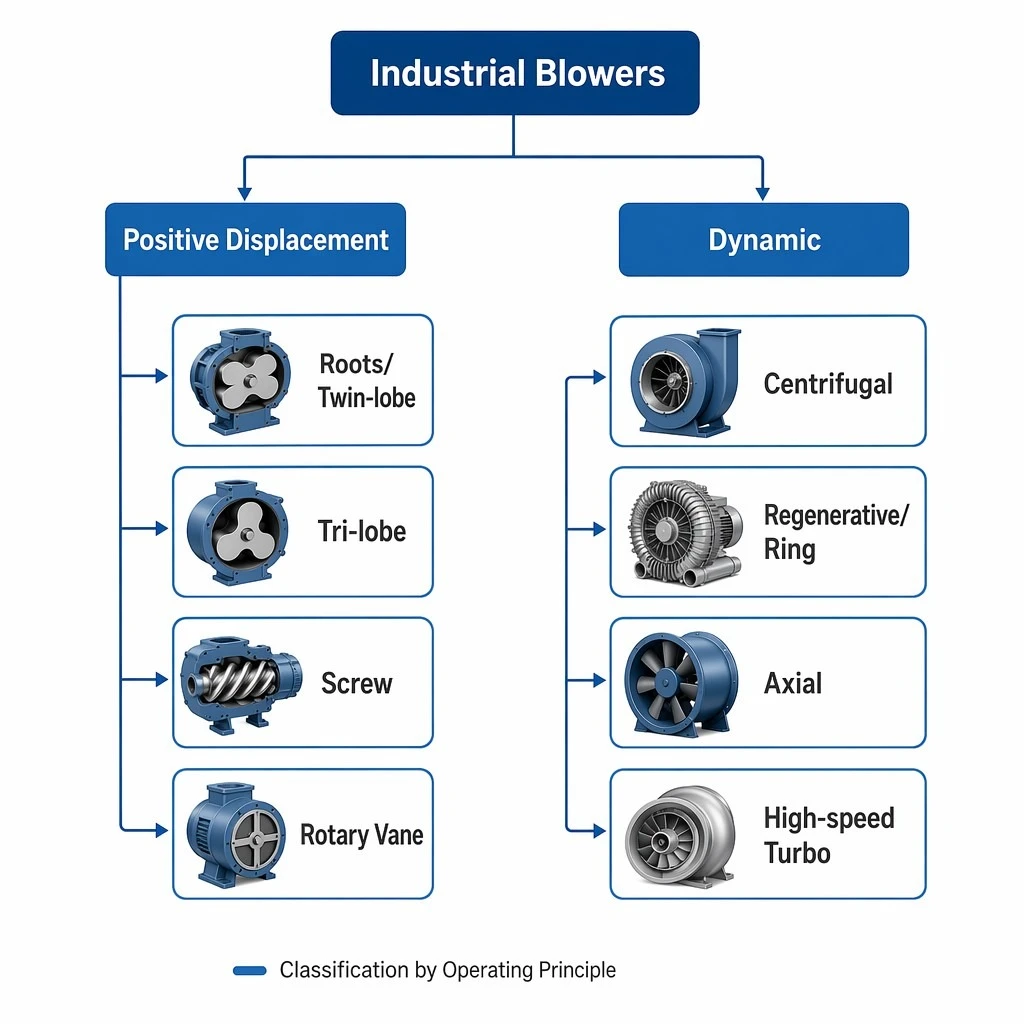
Dynamic blowers accelerate air through a rotating impeller and convert velocity into pressure. Sub-types include:
- **Centrifugal blowers:** Air enters axially and exits radially. Forward-curved (high volume, low pressure, 60–70% efficiency), backward-curved (higher pressure, 80–88% efficiency), and radial-blade (particulate-tolerant) variants. Used in HVAC, dust collection, and combustion air supply.
- **Regenerative blowers (ring/side channel):** Air recirculates between impeller blades and a side channel, gaining energy with each pass. Single-stage (250–350 mbar), double-stage (450–600 mbar). Oil-free, compact, continuous-duty capable.
- **Axial fans:** Air moves parallel to the shaft. High volume (>10,000 CFM), very low pressure (<50 mbar). Used for ventilation, cooling towers, and condenser air movement. Not considered true "blowers" in industrial contexts.
- **High-speed turbo blowers:** Permanent magnet motors spinning at 20,000–60,000 RPM on air-foil bearings. 85–92% efficiency, variable speed, no contact wear. The newest category, rapidly gaining share in large wastewater plants.
Counting variations within these sub-types - single vs multi-stage, direct-drive vs belt-drive, open vs enclosed impellers - the total number exceeds **15 distinct configurations**. But for practical sourcing decisions, the choice nearly always reduces to three: Roots for high-pressure, guaranteed-flow applications; centrifugal for high-volume, fixed-pressure systems; and regenerative for the middle ground where oil-free, continuous, moderate-pressure operation is the priority.