


When sourcing industrial air-moving equipment, one of the first questions buyers ask is: what are the two types of blowers? Understanding this fundamental distinction helps you choose the right machine for your application - whether you are building a wastewater treatment system, running a pneumatic conveying line, or setting up an aquaculture farm.
Industrial blowers fall into two main categories: positive displacement blowers and dynamic blowers. Each works on a different mechanical principle and serves distinct operational needs.
Positive Displacement Blowers
Positive displacement blowers trap a fixed volume of air and force it through the system. The most common type is the Roots blower (also called a lobe blower), which uses two or three interlocking lobes rotating in opposite directions inside a casing. As the lobes turn, air is captured in the pockets between the lobes and the housing, then discharged at the outlet.
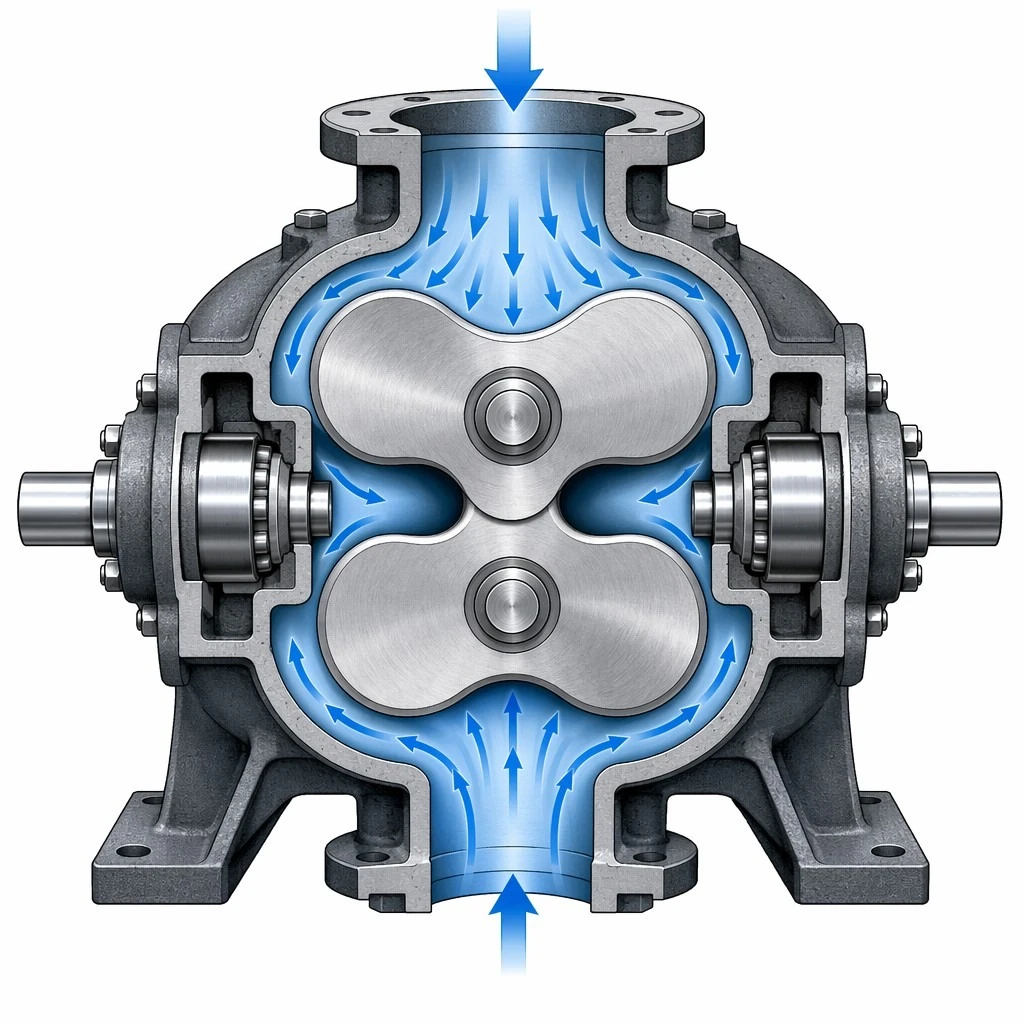
Diagram: Positive Displacement (Roots) Blower - Internal Lobe Mechanism
These blowers deliver a constant volume regardless of pressure changes, making them ideal for applications that demand steady airflow against varying resistance - such as cement conveying, water treatment aeration, and vacuum truck operations. However, they tend to be louder, require oil lubrication, and need more frequent maintenance compared to dynamic alternatives.
Dynamic Blowers (Including Regenerative Blowers)
Dynamic blowers accelerate air using a high-speed rotating impeller and convert velocity into pressure. Within this category, regenerative blowers (also known as side channel blowers or ring blowers) stand out for their unique operating principle: air enters the impeller, gets accelerated outward into a side channel, then recirculates back to the impeller blades - gaining energy with each pass. This regenerative cycle produces higher pressure than a standard centrifugal fan while maintaining oil-free, pulsation-free airflow.
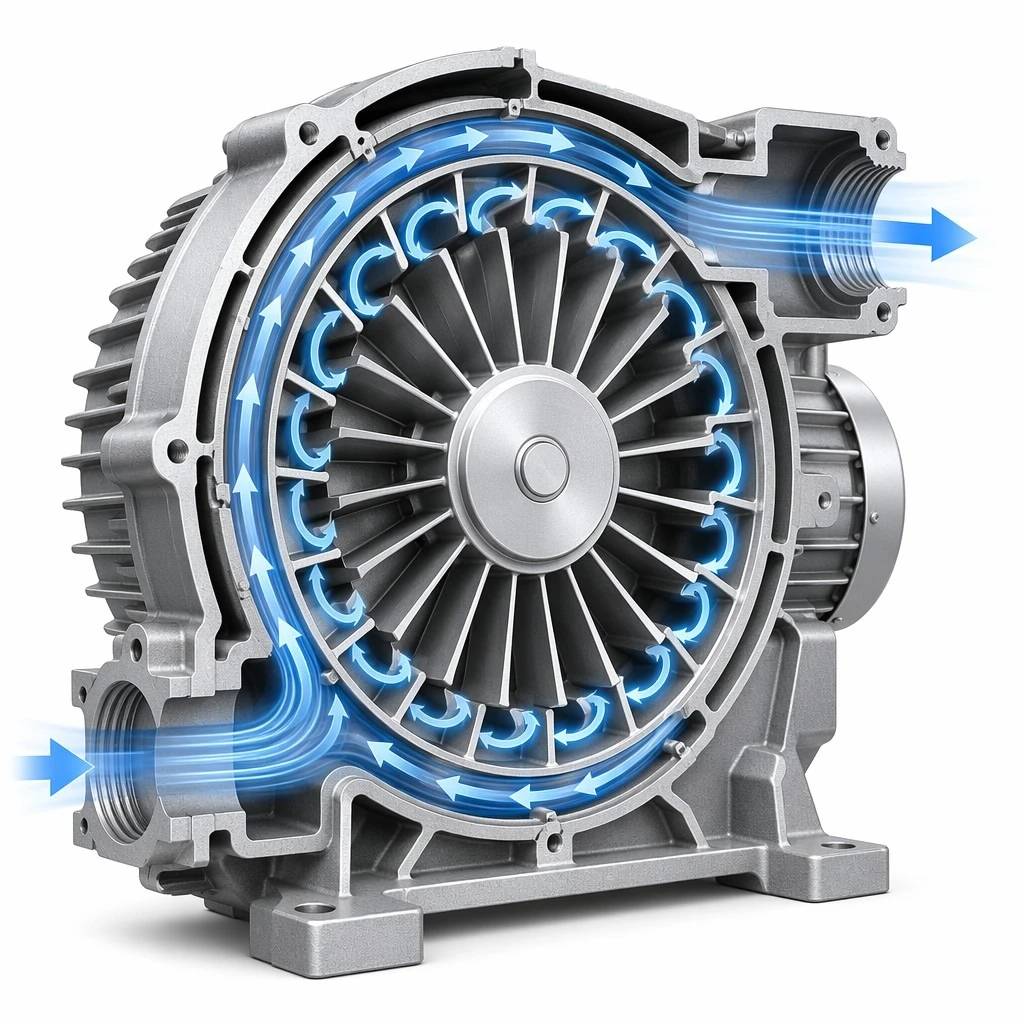
Diagram: Regenerative (Side Channel) Blower - Impeller & Side Channel Air Recirculation
Regenerative blowers excel in applications that need clean, continuous operation: aquaculture oxygenation, printing press paper handling, vacuum lifting, smoke extraction, and medical equipment. Their compact aluminum alloy construction, low noise levels (typically 60-75 dB(A)), and near-zero maintenance requirements make them the preferred choice for modern industrial systems across Asia, the Middle East, and South America.
Which Type Should You Choose?
|
Feature |
Positive Displacement (Roots) |
Regenerative (Side Channel) |
|
Maximum Pressure |
Up to 1 bar |
Up to 0.6-0.8 bar |
|
Airflow Quality |
Pulsating |
Smooth, pulsation-free |
|
Oil Requirement |
Oil-lubricated |
100% oil-free |
|
Noise Level |
80-95 dB(A) |
60-75 dB(A) |
|
Maintenance |
Regular oil changes |
Minimal (bearings only) |
|
Best For |
Heavy material conveying, high-pressure processes |
Clean air applications, continuous duty, vacuum + pressure |
Bottom line: if you need brute pressure for moving solids, go positive displacement. If you need clean, quiet, low-maintenance air movement for sensitive processes, a regenerative blower is your answer.
Looking for high-performance regenerative blowers? Browse our product catalog or contact our engineering team for a custom solution tailored to your industrial application.